
PDAB Policy Center
States are setting drug prices. Patients are largely absent from the table.
Prescription Drug Affordability Boards (PDABs) are state-level bodies with the authority to set drug prices and reimbursement rates. They're spreading quickly — and the evidence so far does not support the assumption that price-setting alone improves patient access.
CANN's PDAB Policy Center tracks where boards are active, what they're deciding, and how those decisions are likely to play out for people who rely on the affected medications. Our analysis centers two questions PDAB statutes rarely answer: who benefits from the savings, and what happens to patient access when reimbursement rates drop below the cost of dispensing.
Where are PDABs Active?
PDAB activity now spans more than a third of U.S. states — some with boards in operation, others with legislation under active consideration. Select a state below to see its enabling statute, the board's meeting and rulemaking record, and CANN's public comments, written testimony, and op-eds.
A Patient's Guide to PDABs
Educational and analytical reads — what PDABs are, who they affect, and the policy questions states haven't answered. Spans 2023–present, updated as new boards take action.


Our Latest Analysis
Watch our PDAB Explainer Videos


Watch our PDAB Webinar

Prescription Drug Affordability Boards: What They Are and How They Impact Patients
Infographics
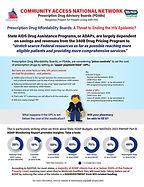
Each infographic in CANN's PDAB series distills one piece of our analysis into a single-page brief — how the boards work, where they're active, the patient populations most affected, and the policy tension points around 340B, ADAP, and the Americans with Disabilities Act. Built for quick reference and easy sharing.


Policy Resources
CANN's full-length PDAB policy papers and the underlying data sit alongside a curated set of outside analyses — industry research, insurer perspectives on Upper Payment Limits, and patient advocacy work on care equality. Use these to dig deeper into what the boards are doing and how their decisions are likely to play out.
Response Project for People Living with HIV
Published: January 18, 2024
CANN's foundational PDAB analysis — how the boards are structured, why their Upper Payment Limit mechanism threatens 340B-funded HIV care, and what patient-centered alternatives the policy debate has overlooked.

The source spreadsheet behind CANN's ADA analysis — every PDAB-eligible drug across Colorado, Maryland, Oregon, and Washington, tagged by primary condition category and ADA classification for independent review.

Impact of State PDABs on Access to Medications for Potentially Disabling Conditions
Published: July 23, 2024
Original data analysis of every PDAB-eligible drug in Colorado, Maryland, Oregon, and Washington, showing the boards disproportionately target medications for ADA-protected conditions — and raising disparate-impact concerns.

Across the policy conversation
Outside analyses worth weighing alongside CANN's own — pharmaceutical industry perspective, insurer-focused research, and patient advocacy critique. Each link opens its original source.