
HIV/HCV Co-Infection Watch Q3: July 2026

The HIV/HCV Co-Infection Watch is a project of the Community Access National Network (CANN) designed to research, monitor, and report on HIV and Hepatitis C (HCV) co-infection in the United States. The July 2026 Watch includes timely updates herein. To read the project disclaimer and/or methodology, CLICK HERE.
TABLE OF CONTENTS:
1. FINDINGS
The following is a summary of the key findings for July 2026:
AIDS Drug Assistance Programs:
There are 56 state and territorial AIDS Drug Assistance Programs (ADAPs) in the United States. Forty-three (43) offer some form of coverage for Hepatitis C (HCV) treatment; forty (40) cover at least one Direct-Acting Antiviral (DAA) regimen, the current Standard of Care; and thirty-eight (38) cover at least one pangenotypic agent. Three (3) programs — Alaska, South Carolina, and the Federated States of Micronesia — offer only Basic Coverage. Fifteen (15) offer no coverage, though that number combines eight programs whose published formularies exclude HCV medications with seven that publish no formulary at all. Only twenty-two (22) programs cover Vosevi, the sole salvage agent after DAA failure. American Samoa and the Northern Mariana Islands are documented for the first time this quarter, leaving no jurisdiction wholly unexamined.
Two programs changed published coverage: Montana ended Basic Coverage by removing ribavirin, and California completed its transition to an open formulary. The most significant federal development was the introduction of the Cure Hepatitis C Act of 2026 (H.R. 9682) in the House on July 14, proposing a subscription purchasing model that would eliminate both cost-sharing and prior authorization for covered populations.
A state-by-state Drug Formulary breakdown is included in the July 2026 Updates, with drug-specific maps in Figures 1 – 10.
Medicaid Programs:
There are 59 state and territorial Medicaid programs in the United States. All 50 states and the District of Columbia continue to offer Expanded Coverage, and each covers at least one pangenotypic DAA. Mavyret is covered in 46 states and D.C. and preferred in 43; generic Epclusa is covered in 43 and preferred in 37.
The principal finding this quarter is the return of fibrosis staging as a condition of treatment in seven state Medicaid programs — Missouri, Maryland, West Virginia, Washington, Montana, South Carolina, and Massachusetts. Two of the governing documents were issued this quarter, and West Virginia’s own changelog shows a requirement it had removed in 2019 now reinstated. No state sets a minimum fibrosis stage, meaning the barrier is the test rather than the disease stage. This contradicts language carried in prior editions stating that all state Medicaid programs had maintained the removal of fibrosis restrictions for initial treatment.
Four territories — Puerto Rico, the U.S. Virgin Islands, Guam, and American Samoa — are reported for the first time in the history of the Watch. American Samoa’s sole Medicaid provider stocks no hepatitis C treatment of any kind. The freely associated states of Micronesia, the Marshall Islands, and Palau have no United States Medicaid program and are excluded from all denominators.
No state Medicaid program requires sobriety as a prerequisite for treatment. A complete state-by-state PDL breakdown is included in the July 2026 Updates, with drug-specific maps in Figures 11 – 20.
Patient Assistance Programs:
Good Days is the only charitable co-pay fund for hepatitis C accepting applications this quarter. Patient Advocate Foundation's Co-Pay Relief and the Patient Access Network Foundation merged and relaunched as TotalAssist on July 1, 2026, and both of its hepatitis C funds are closed. HealthWell has been closed since late 2025. The Assistance Fund remains waitlisted. That matters more than it may appear: charitable foundations are the only assistance route open to people insured through Medicare or Medicaid, because every manufacturer co-pay card is statutorily required to exclude government-insured patients. Four of the five charitable funds the Watch tracks are shut, and the entire cost-sharing safety net for Medicare and Medicaid beneficiaries with hepatitis C now rests on one fund with a $2,100 award.
Harm Reduction Programs:
Syringe Services Programs: Forty-three (43) states, the District of Columbia and two (2) territories currently have Syringe Services Programs (SSPs) in place, regardless of the legality. Seven (7) states without SSPs are Alabama, Idaho, Kansas, Mississippi, Nebraska, South Dakota, and Wyoming. Idaho's situation reflects the most significant change, having repealed its Syringe and Needle Act (House Bill 617) effective July 1, 2024, becoming the first state to completely eliminate authorized syringe services programs.
Expanded Naloxone Access: All fifty (50) states and the District of Columbia have health department distribution programs for Naloxone and/or allow Medicaid coverage of Naloxone. No states have restricted naloxone access, with innovative distribution methods emerging including vending machine programs in Denver (2,100+ boxes distributed), St. Louis County (44 new machines), and California's direct-to-consumer CalRx program offering naloxone at $24 per twin-pack.
Safe Consumption Sites: Two (2) states explicitly authorize or have authorized pilot projects for Safe Consumption Sites (SCSs): New York (operational since November 2021) and Rhode Island (opened December 2024). Rhode Island's authorization now runs to March 1, 2028: the General Assembly passed H 5171 Substitute A and Governor McKee signed it June 6, 2025, extending the harm reduction center program by two years.
Updated Paraphernalia Laws: Forty-nine (49) states have modernized their criminal codes to allow for possession of testing strips and may also have health department programs distributing testing strips. Indiana decriminalized fentanyl test strips effective July 1, 2025, through House Bill 1167. Iowa remains the only state where testing strips are still explicitly categorized as illegal paraphernalia.
Good Samaritan Laws: Twenty-five (25) states have Good Samaritan laws or statutes that provide some level of protection for those seeking or giving assistance during a drug overdose, regardless of possession of controlled substances or consumption of illegal or illicit substances. No new states added Good Samaritan protections during the research period.
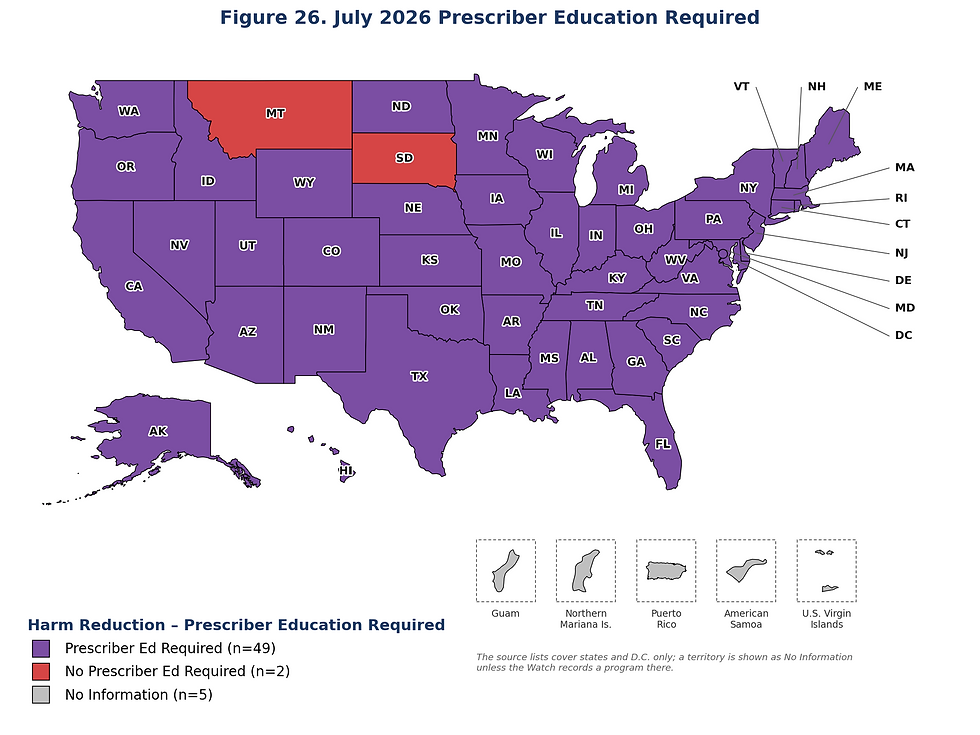
Prescriber Education: Forty-eight (48) states and the District of Columbia require, through legislative action or regulatory or licensing bodies, that prescribing physicians attend mandatory and continuing opioid prescribing or harm reduction education sessions. Montana and South Dakota remain the only states without these requirements. A state-by-state program breakdown is included in the October 2025 Updates, with accompanying maps in Figures 21-26.
2. AIDS DRUG ASSISTANCE PROGRAMS (ADAPs) & HCV THERAPIES
Of the 56 respective state and territorial ADAPs, 15 do not offer any coverage for HCV drug therapies: GA, KS, KY, MO, NM, OH, TX, UT, VT, AS, GU, MP, MH, PW, and V.I. Eight publish a formulary that excludes HCV medications; the remainder publish no formulary the Watch could locate. States whose formularies are not available on the state-run website have been checked against the most recent National Alliance of State and Territorial AIDS Directors (NASTAD) formulary database (last updated January 1, 2026). The data presented are current as of July 27, 2026.
July 2026 Updates:
Basic Coverage
States with Basic HCV Medications Coverage: AL, AK, AZ, AR, CA, CO, CT, DE, FL, HI, IL, IN, IA, LA, ME, MD, MA, MI, MN, NE, NV, NH, NJ, NY, NC, ND, OK, PA, RI, SC, SD, VA, WA, WV, WI, WY, D.C.
States without Basic HCV Medications Coverage: GA, ID, KS, KY, MS, MO, MT, NM, OH, OR, TN, TX, UT, VT
Territories with Basic HCV Medications Coverage: P.R., F.S.M.

Sovaldi
States with Sovaldi Coverage: AZ, CA, CO, HI, IL, IN, IA, LA, ME, MD, MA, MN, NE, NV, NJ, ND, OK, SD, VA, WA, WI, WY, D.C.
States without Sovaldi Coverage: AL, AK, AR, CT, DE, FL, GA, ID, KS, KY, MI, MS, MO, MT, NH, NM, NY, NC, OH, OR, PA, RI, SC, TN, TX, UT, VT, WV
Territories with Sovaldi Coverage: P.R.

Harvoni
States with Harvoni Coverage: AZ, AR, CA, CO, CT, DE, FL, HI, ID, IL, IN, IA, LA, ME, MD, MA, MI, MN, MS, MT, NE, NV, NJ, NC, ND, OK, OR, SD, TN, VA, WA, WI, WY, D.C.
States without Harvoni Coverage: AL, AK, GA, KS, KY, MO, NH, NM, NY, OH, PA, RI, SC, TX, UT, VT, WV
Territories with Harvoni Coverage: P.R.

Zepatier
States with Zepatier Coverage: AL, AZ, AR, CA, CO, FL, HI, IL, IA, LA, ME, MD, MA, MI, MN, MS, MT, NE, NV, NJ, NY, NC, ND, OR, PA, SD, VA, WA, WV, WI, WY, D.C.
States without Zepatier Coverage: AK, CT, DE, GA, ID, IN, KS, KY, MO, NH, NM, OH, OK, RI, SC, TN, TX, UT, VT
Territories with Zepatier Coverage: P.R.

Epclusa
States with Epclusa Coverage: AZ, AR, CA, CO, CT, FL, HI, ID, IL, IN, IA, LA, ME, MD, MA, MI, MN, MS, MT, NE, NV, NJ, ND, OR, PA, SD, TN, VA, WA, WI, WY
States without Epclusa Coverage: AL, AK, DE, GA, KS, KY, MO, NH, NM, NY, NC, OH, OK, RI, SC, TX, UT, VT, WV, D.C.
Territories with Epclusa Coverage: P.R.

Vosevi
States with Vosevi Coverage: CA, CO, CT, FL, HI, ID, IL, IN, IA, LA, ME, MD, MA, MN, NE, NV, NJ, ND, SD, TN, WA, WY
States without Vosevi Coverage: AL, AK, AZ, AR, DE, GA, KS, KY, MI, MS, MO, MT, NH, NM, NY, NC, OH, OK, OR, PA, RI, SC, TX, UT, VT, VA, WV, WI, D.C.
Territories with Vosevi Coverage: P.R.

Pegasys
States with Pegasys Coverage: AL, CA, CT, DE, HI, IL, IA, LA, ME, MD, MA, MI, MN, NE, NV, NH, NJ, NY, NC, ND, OK, PA, RI, SD, WA, WV, WI, WY, D.C.
States without Pegasys Coverage: AK, AZ, AR, CO, FL, GA, ID, IN, KS, KY, MS, MO, MT, NM, OH, OR, SC, TN, TX, UT, VT, VA
Territories with Pegasys Coverage: None/Unknown

Mavyret
States with Mavyret Coverage: AL, AR, CA, CO, CT, FL, HI, ID, IL, IN, IA, LA, ME, MD, MA, MI, MN, MS, MT, NE, NV, NH, NJ, NY, NC, ND, OR, PA, RI, SD, TN, VA, WA, WV, WI, WY, D.C.
States without Mavyret Coverage: AK, AZ, DE, GA, KS, KY, MO, NM, OH, OK, SC, TX, UT, VT
Territories with Mavyret Coverage: P.R.

Harvoni (generic)
States with Harvoni (generic) Coverage: AR, CA, CO, CT, DE, FL, IL, IA, LA, ME, MD, MA, MN, MS, MT, NE, NV, NH, NJ, NC, ND, OR, SD, TN, VA, WA, WY
States without Harvoni (generic) Coverage: AL, AK, AZ, GA, HI, ID, IN, KS, KY, MI, MO, NM, NY, OH, OK, PA, RI, SC, TX, UT, VT, WV, WI, D.C.
Territories with Harvoni (generic) Coverage: P.R.

Epclusa (generic)
States with Epclusa (generic) Coverage: AR, CA, CO, CT, FL, IL, IA, LA, ME, MD, MA, MN, MS, MT, NE, NV, NH, NJ, ND, OR, PA, SD, TN, VA, WA, WY
States without Epclusa (generic) Coverage: AL, AK, AZ, DE, GA, HI, ID, IN, KS, KY, MI, MO, NM, NY, NC, OH, OK, RI, SC, TX, UT, VT, WV, WI, D.C.
Territories with Epclusa (generic) Coverage: P.R.

State and Territory ADAP Formulary Notes:
Alaska
Publishes no ADAP formulary. One is named in the governing documents — set by "the HIV/STD Program" — but never published. Ten locations were checked, including the NASTAD database. Coverage values are carried forward from the prior edition and are not independently verified.
American Samoa
Documented for the first time; publishes no ADAP formulary.
Arizona
Removed Mavyret effective February 13, 2026. The formulary's Summary of Changes records "02/13/2026 – All AbbVie products removed from Formulary." Arizona ADAP now covers no glecaprevir/pibrentasvir.
Colorado
Offers five coverage options — Standard ADAP, HIV Medical Assistance Program (HMAP), Bridging the Gap Colorado (BTGC), HIV Insurance Assistance Program (HIAP), and Supplemental Wrap Around Program (SWAP). "Yes" indications in Figure 1 for Colorado denote that at least one of these programs offers coverage for each respective drug. Coverage through the Standard ADAP Formulary remains subject to funding availability.
Georgia
Has not changed which medications it will cover. The HEP C program is currently on hold until future funding is available. The website instructs patients to utilize patient assistance programs for HEP C medications.
Hawaii
ADAP notes: "Treatment slots for HCV direct-acting antivirals may be limited. Prescriber or pharmacy must call HDAP for slot."
Idaho
Applies no restrictions to the four DAAs it covers. The Criteria/Notes column is blank for Mavyret, Harvoni, Epclusa, and Vosevi while other classes on the same page carry restrictions — an affirmative absence rather than an omission.
Louisiana
ADAP (Louisiana Health Access Program – LA HAP) offers two coverage options — Uninsured (Louisiana Drug Assistance Program – L-DAP) and Insured (Health Insurance Program – HIP). HIP pays for the cost of treatment only if the client's primary insurance covers the drug under its formulary.
Missouri
No longer covers Ribavirin, Mavyret, or Epclusa (Brand) as it had previously. Effective June 1, 2026, the Missouri Ryan White Part B program removed non-HIV medications from its ADAP Formulary.
Montana
No longer covers Ribavirin but added coverage for Harvoni (both Brand and Generic) and Epclusa (both Brand and Generic). Before July 2026, Montana had not updated its published ADAP formulary since 2019.
Northern Mariana Islands
Documented for the first time; publishes no ADAP formulary. CNMI's approved State Plan Amendment MP-23-0006 makes coverage turn on a "CNMI Medicaid Drug Formulary" that is legally operative and published nowhere.
Pennsylvania
No longer covers Sovaldi or Harvoni (Brand).
Texas
ADAP maintains no HCV coverage, despite a brief period of covering DAAs in 2022.
Utah
Publishes no ADAP formulary. Two are named in the governing documents — the ADAP-M list and the ADAP-I formulary — and neither is published. Nine locations were checked, including the NASTAD database. Coverage values are carried forward from the prior edition and are not independently verified.
Cross-Program Notes
Salvage therapy is the narrowest coverage of any tracked drug. Twenty-two programs cover Vosevi. Clients in the remaining programs who do not achieve sustained virologic response have no listed re-treatment option.
Peginterferon alfa-2a (Pegasys) is in FDA-listed shortage. The product transferred from Roche/Genentech to pharmaand GmbH, which operates a patient support line at 855-443-7028. Pegasys is no longer standard of care for hepatitis C, so the shortage's practical effect on hepatitis C treatment is limited, but it bears on the Basic Coverage and Pegasys rows in Sections 2 and 3.
Open Formularies
Programs identified as operating open formularies: CA, IL, IA, MA, MN, NE, NH, NJ, NM, ND, OH, OR, WA, WY
Verified Open Formulary
California
Transitioned to an open formulary and changed pharmacy benefit managers. Per the program: "OA has transitioned ADAP to an open formulary model. This means all FDA-approved medication will be included (with some exceptions due to safety concerns or cost)… and will align ADAP more closely with Medi-Cal's broad medication coverage, reducing treatment interruptions." All ten tracked drugs are covered, including both Asegua authorized generics, and no hepatitis C National Drug Code carries a prior authorization flag. The formulary moved from Magellan to Prime Therapeutics; the former address now redirects to an unrelated commercial site.
Open Formulary with HCV Carveout
New Hampshire
Updated its formulary to require step therapy for Sovaldi, Harvoni, Zepatier, Epclusa, and Vosevi effective July 1, 2025. Preferred drugs are ribavirin, Pegasys, Mavyret, generic Harvoni, and generic Epclusa. This change affects coverage for brand-name DAAs, requiring patients to try preferred medications first.
North Dakota
Has adopted an open formulary but provides only co-pay and deductible assistance for HCV medications.
Ohio
Listed by NASTAD as having an open formulary, but both NASTAD's ADAP Formulary Database and Ohio's ADAP website indicate that the state does not offer any treatment for HCV.
Oregon
CAREAssist coverage is narrower than previously reported. Section B of the Preferred Network formulary is expressly closed: "Hepatitis C drugs when insurance denies or if client has no insurance (coverage includes these medications ONLY)." Four treatments are covered — glecaprevir/pibrentasvir, ledipasvir/sofosbuvir, velpatasvir/sofosbuvir, elbasvir/grazoprevir. Ribavirin, peginterferon, sofosbuvir alone, and Vosevi are not. The program also states that "Treatment for Hepatitis C regimens are limited by program funding," and insured clients' providers must appeal the primary payer's denial before CAREAssist will consider a request.
Wyoming
ADAP Open Formulary document carries the following disclaimer related to HCV: Hepatitis C treatment medications (i.e. Harvoni, Sovaldi, Ribavirin, Zepatier, Epclusa) must be prior authorized. To be eligible, clients must have applied for prior authorization from their insurance plan and the WY ADAP Hepatitis C Treatment checklist must be completed and signed by the provider and client.
3. MEDICAID PROGRAMS & HCV THERAPIES
All 50 states and the District of Columbia list at least one hepatitis C direct-acting antiviral on their preferred drug lists. Coverage as this Watch scores it is narrower: a program is counted as covering a drug only where a patient can actually obtain it, meaning step therapy, fibrosis staging, and undocumented authorization standards score as no coverage. Four territorial Medicaid programs are reported here for the first time — Puerto Rico, the U.S. Virgin Islands, Guam, and American Samoa. The Northern Mariana Islands publishes no formulary. Micronesia, the Marshall Islands, and Palau have no United States Medicaid program and are excluded. The data presented are current as of July 27, 2026.
July 2026 Updates:
Basic Coverage
States with Basic HCV Medications Coverage: AL, AK, AZ, AR, CA, CO, CT, DE, FL, GA, HI, IL, IN, IA, KY, LA, MI, MN, MS, NE, NV, NH, NJ, NY, NC, ND, OH, OK, OR, PA, RI, SD, TN, TX, UT, VT, WA, WI, D.C.
States without Basic HCV Medications Coverage: ID, KS, ME, MD, MA, MO, MT, NM, SC, VA, WV, WY
Territories with Basic HCV Medications Coverage: Guam, P.R., U.S.V.I.

Sovaldi
States with Sovaldi Coverage: AL, AK, AR, CA, CO, FL, GA, HI, ID, IL, IN, IA, KY, LA, MI, MN, MS, NE, NV, NM, NY, ND, OK, OR, RI, SD, TN, UT, VT, WI, WY, D.C.
States without Sovaldi Coverage: AZ, CT, DE, KS, ME, MD, MA, MO, MT, NH, NJ, NC, OH, PA, SC, TX, VA, WA, WV
Territories with Sovaldi Coverage: Guam, U.S.V.I.

Harvoni
States with Harvoni Coverage: AL, AK, AR, CA, CO, FL, GA, HI, ID, IL, IN, IA, KY, LA, MI, MN, MS, NE, NV, NM, NY, ND, OK, OR, RI, SD, TN, UT, VT, WI, WY, D.C.
States without Harvoni Coverage: AZ, CT, DE, KS, ME, MD, MA, MO, MT, NH, NJ, NC, OH, PA, SC, TX, VA, WA, WV
Territories with Harvoni Coverage: U.S.V.I.

Zepatier
States with Zepatier Coverage: AL, AK, AR, CA, CO, FL, GA, HI, ID, IL, IA, KY, LA, MI, MN, MS, NE, NV, NJ, NM, NY, OH, OK, OR, RI, SD, TN, UT, VT, WI, WY, D.C.
States without Zepatier Coverage: AZ, CT, DE, IN, KS, ME, MD, MA, MO, MT, NH, NC, ND, PA, SC, TX, VA, WA, WV
Territories with Zepatier Coverage: None/Unknown

Epclusa
States with Epclusa Coverage: AL, AK, AR, CA, CO, FL, GA, HI, ID, IL, IN, IA, KY, LA, MI, MN, MS, NV, NM, NY, ND, OK, OR, RI, SD, TN, TX, UT, VT, WI, WY, D.C.
States without Epclusa Coverage: AZ, CT, DE, KS, ME, MD, MA, MO, MT, NE, NH, NJ, NC, OH, PA, SC, VA, WA, WV
Territories with Epclusa Coverage: U.S.V.I.

Vosevi
States with Vosevi Coverage: AL, AK, AR, CO, CT, FL, GA, HI, ID, IL, IA, KY, LA, MI, MN, MS, NE, NV, NJ, NM, NY, NC, ND, OK, OR, RI, SD, TN, UT, VT, WI, WY, D.C.
States without Vosevi Coverage: AZ, CA, DE, IN, KS, ME, MD, MA, MO, MT, NH, OH, PA, SC, TX, VA, WA, WV
Territories with Vosevi Coverage: U.S.V.I.

Pegasys
States with Pegasys Coverage: AL, AK, AZ, AR, CA, CT, FL, GA, HI, IL, IN, IA, LA, MI, MN, MS, NE, NH, NJ, NC, OH, OK, OR, RI, SD, TN, VT, WI, D.C.
States without Pegasys Coverage: CO, DE, ID, KS, KY, ME, MD, MA, MO, MT, NV, NM, NY, ND, PA, SC, TX, UT, VA, WA, WV, WY
Territories with Pegasys Coverage: U.S.V.I.

Mavyret
States with Mavyret Coverage: AL, AK, AZ, AR, CA, CO, CT, DE, FL, GA, HI, ID, IL, IN, IA, KS, KY, LA, ME, MI, MN, MS, MO, NE, NV, NH, NJ, NM, NY, NC, ND, OH, OK, OR, PA, RI, SD, TN, TX, UT, VT, VA, WA, WI, WY, D.C.
States without Mavyret Coverage: MD, MA, MT, SC, WV
Territories with Mavyret Coverage: P.R., U.S.V.I.

Harvoni (generic)
States with Harvoni (generic) Coverage: AL, AK, AR, CA, CO, FL, GA, HI, ID, IL, IN, IA, KY, LA, MI, MN, MS, NE, NV, NH, NM, NY, ND, OK, OR, RI, SD, TN, VT, WI, D.C.
States without Harvoni (generic) Coverage: AZ, CT, DE, KS, ME, MD, MA, MO, MT, NJ, NC, OH, PA, SC, TX, UT, VA, WA, WV, WY
Territories with Harvoni (generic) Coverage: Guam, U.S.V.I.

Epclusa (generic)
States with Epclusa (generic) Coverage: AL, AK, AZ, AR, CA, CO, CT, DE, FL, GA, HI, ID, IL, IN, IA, KS, KY, LA, ME, MI, MN, MS, NE, NV, NH, NJ, NM, NY, NC, ND, OH, OK, OR, PA, RI, SD, TN, TX, UT, VT, WI, WY, D.C.
States without Epclusa (generic) Coverage: MD, MA, MO, MT, SC, VA, WA, WV
Territories with Epclusa (generic) Coverage: Guam, P.R., U.S.V.I.

State and Territory Medicaid Formulary Notes:
Fibrosis staging is a condition of approval in seven state Medicaid programs. In each, a fibrosis score or staging test must be produced before treatment is authorized. None sets a minimum stage, meaning early-stage disease is not itself a ground for denial — the barrier is the test. Because the requirement is procedural rather than clinical, it does not register on scorecards that track minimum-fibrosis restrictions, and a state can hold a clean record on "no fibrosis restriction" while still requiring a FibroScan before it will pay.
Missouri — criteria revised July 9, 2026. Applies to every DAA except Mavyret, which needs no prior authorization: "Documented fibrosis score (fibrosis score of F4 also requires a Child-Pugh score to be submitted)." Missouri includes a named reference-product step in the same combined list — "Documentation for why Mavyret cannot be utilized for the participant."
Maryland — new clinical criteria issued May 2026, replacing the January 7, 2021 edition. Reaches every hepatitis C agent on the PDL; the clinical-criteria marker sits on Epclusa, Mavyret, Vosevi, Harvoni, Sovaldi, and Zepatier alike. Maryland imposes no step therapy, no sobriety rule, and no specialty restriction — staging is its only barrier.
West Virginia — "All requests must supply a fibrosis score and at least one detectable HCV viral level, both obtained within 6 months prior to the start of therapy," with "Failure to report a genotype, fibrosis score, viral load" listed as a ground for denial. The state's own changelog records that version 2019.3b, September 6, 2019, "Removed fibrosis requirement." It has since been reinstated.
Washington — policy 12.35.30.99 requires for every non-preferred DAA a "Fibrosis staging test (e.g. FibroScan or FibroSURE)… Fibrosis staging test results must be less than 2 years old." Mavyret, the sole preferred agent, requires no prior authorization and is unaffected.
Massachusetts — form PA-38 (Rev. 01/26) requires prescribers to "attach documentation including medical records and results of diagnostic tests assessing liver disease staging (e.g., APRI, Fibroscan, Fibrosure, FIB-4)," and states that "Staging information must clearly demonstrate early stage (Metavir Score F0 to F2) or advance liver disease (Metavir Score F3 to F4)." Every agent in MassHealth's hepatitis C table carries prior authorization.
South Carolina — "Staging of liver disease (Metavir score)" appears among eighteen laboratory results the prescriber "must submit copies of… within 6 months of the request." APRI and FIB-4 are accepted, both calculable from labs already required. Clinical criteria apply to every drug in the class.
Montana — a stage must be recorded on both approval pathways, including the eight-week Mavyret fast track, granted only when "Treatment Naive" and "Liver Fibrosis Stage F0, F1, F2, F3 or F4 (cirrhosis-compensated)" are both checked.
Two states changed published coverage. Wyoming removed generic Harvoni from its June 8, 2026 preferred drug list; the class now lists sofosbuvir/velpatasvir and Mavyret as preferred and Epclusa, Harvoni, Sovaldi, Vosevi, and Zepatier as non-preferred, with no generic ledipasvir/sofosbuvir row. Idaho moved generic Epclusa from preferred to non-preferred effective July 1, 2026, though Idaho imposes no step therapy, therefore the practical effect is limited.
Four territories are reported for the first time. Puerto Rico's Plan Vital covers two treatments — Mavyret and the authorized generic of Epclusa — plus ribavirin, with no salvage agent; note the PDL is split into eleven sub-formularies and ribavirin appears only on the VIH/SIDA list. The U.S. Virgin Islands lists nine of the ten tracked drugs, the broadest territorial formulary, but the governing document's printed validity expired March 31, 2024 and nothing supersedes it. Guam covers Sovaldi, both authorized generics, and ribavirin, and no glecaprevir/pibrentasvir. American Samoa's sole Medicaid provider, LBJ Tropical Medical Center, stocks no hepatitis C treatment of any kind — its formulary contains no DAA, no ribavirin, and no interferon, though it carries hepatitis B immune globulin and vaccine.
Territorial coverage is not directly comparable to a state's. None of Guam, American Samoa, the Northern Mariana Islands, or the U.S. Virgin Islands participates in the Medicaid Drug Rebate Program; each is waived out and operates under a Section 1108 capped allotment at a 55% federal match. Their formularies are locally negotiated closed benefits. The freely associated states of Micronesia, the Marshall Islands, and Palau have no United States Medicaid program under Section 1101(a)(1) of the Social Security Act and should be excluded from any denominator.
Rhode Island does cover the authorized generic of Epclusa. Sofosbuvir/velpatasvir is printed as its own line item on the June 16, 2026 preferred drug list, non-preferred and subject to prior authorization. Non-preferred means authorization, not exclusion, and Rhode Island's authorization pathway carries no treatment-failure requirement, no fibrosis restriction, no sobriety requirement, and no specialty restriction. The statement that Rhode Island is the only state not covering generic Epclusa has been removed.
Kansas covers two direct-acting antivirals as preferred with no clinical gate. The absence of restriction there is the result of litigation: Harper v. Andersen, brought by the ACLU of Kansas and settled in 2018–2019, ended KanCare's fibrosis-stage restriction. It is a useful precedent for the seven states that have since reintroduced staging by a different route.
The following states’ Medicaid programs offer multiple coverage plans for their respective Medicaid clients. The plan highlighted in bold typeface represents the most comprehensive plan with the most drugs covered in the respective state:
Hawaii – (1.) Alohacare Advantage Plus; (2.) HMSA; (3.) Kaiser Permanente; (4.) UnitedHealthcare QUEST Integration; (5.) WellCare
New Jersey – (1.) Aetna; (2.) AmeriGroup NJ (Now Wellpoint); (3.) Horizon NJ Health; (4.) UnitedHealthcare of New Jersey (New Jersey Family Care);
New Mexico – (1.) BlueCross BlueShield of New Mexico; (2.) Presbyterian Centennial Care; (3) Western Sky Community Care
Kentucky has a Unified Medicaid Formulary
Louisiana has a Unified Medicaid Formulary
Ohio – Ohio has a Unified Medicaid Formulary that applies to all MCOs
Indiana - Harvoni, Sovaldi, Vosevi, and generic Harvoni are now non-preferred, requiring failure of preferred agents plus prior authorization
New Hampshire - Epclusa, Harvoni, Sovaldi, Vosevi, and Zepatier are now non-preferred, requiring failure of preferred options before allowing use
Continuing Policies:
There are currently no states that require sobriety as a prerequisite for hepatitis C treatment.
For clarification, if a state requires a complicated prior authorization process or step therapy requiring failure on preferred medications, that is considered 'no coverage'.
*Due to inducement requirements, no patient utilizing Medicaid or Medicare qualify for manufacturer PAPs
4. VETERANS PROGRAMS & HCV THERAPIES
The Veteran's Administration (VA) currently offers coverage for all HCV drugs. This is according to the most recent VA National Formulary, dated October 2025 (U.S. Dept. of V.A., 2025a). The VA Treatment Considerations and Choice of Regimen for HCV-Mono-Infected and HIV/HCV Co-Infected Patients, dated March 2021 (U.S. Dept. of V.A., 2021b) lists the following therapies as preferred treatments:
Abbreviations:
- CTP – Child-Turcotte-Pugh (score used to assess severity of cirrhosis) - IU/mL – International Units Per Milliliter - PEG-IFN/IFN – Peginterferon/Interferon - RAS – Resistance-associated substitutions
Genotype 1:
Treatment-naïve without or with cirrhosis (CTP A):
Pangenotypic regimens
Mavyret: 3 tablets orally daily with food for 8 weeks; may consider 12 weeks in patients with poor prognostic factors
Epclusa: 1 tablet orally daily for 12 weeks
Non-pangenotypic regimens:
Zepatier: 1 tablet orally daily for 12 weeks if GT1a without baseline NS5A RAS or GT1b
Harvoni: 1 tablet orally daily
If HCV-noninfected, non-cirrhotic, and HCV RNA baseline <6 million IU/mL: 8 weeks
If cirrhotic, baseline HCV RNA ≥6 million IU/mL, HIV/HCV-co-infected, or African American: 12 weeks
Consider adding ribavirin in CTP A patients
Treatment-naïve with decompensated cirrhosis (CTP B or C):
Harvoni: 1 tablet orally daily + ribavirin (600 mg/day and increase by 200 mg/day every 2 weeks only as tolerated) for 12 weeks
Epclusa: 1 tablet orally daily + ribavirin (1000 mg/day - <75kg – or 1,200 mg daily - ≥75kg – orally daily in 2 divided doses with food) for 12 weeks; start at lower ribavirin doses as clinically indicated (e.g., baseline Hgb).
Treatment-experienced (NS5A- and SOF-naïve [e.g., failed PEG-IFN/RBV ± NS3/4A PI]) without or with cirrhosis (CTP A)
Pangenotypic regimens:
Mavyret: 3 tablets orally daily with food
If PEG-IFN/RBV-experienced: 8 weeks if non-cirrhotic or 12 weeks if cirrhotic
If NS3/4A PI + PEG-IFN/RBV-experienced: 12 weeks
Vosevi: 1 tablet orally daily for 12 weeks
Non-pangenotypic regimens
Zepatier: 1 tablet orally daily for 12 weeks if GT1b, or if failed only PEG-IFN/RBV and GT1a without baseline NS5A RAS
Harvoni: 1 tablet orally daily for 12 weeks
Treatment-experienced (NS5A-naïve and SOF-experienced) without or with cirrhosis (CTP A)
Mavyret: 3 tablets orally daily with food
If PEG-IFN/RBV + Sovaldi-experienced: 8 weeks if non-cirrhotic or 12 weeks if cirrhotic
If Olysio + Sovaldi-experienced: 12 weeks
Epclusa: 1 tablet orally daily for 12 weeks if GT1b
Vosevi: 1 tablet orally daily with food for 12 weeks if GT1a
Treatment-experienced (prior NS5A-containing regimen) without or with cirrhosis (CTP A)
Mavyret: 3 tablets orally daily with food for 16 weeks if failed only an NS5A inhibitor without NS3/4A PI (e.g., Harvoni)
Vosevi: 1 tablet orally daily with food for 12 weeks
Treatment-experienced with decompensated cirrhosis (CTP B or C)
Epclusa: 1 tablet orally daily + RBV; start at lower RBV doses as clinically indicated (e.g., baseline Hgb);
If NS5A-naïve: 12 weeks
If NS5A-experienced: 24 weeks; NOT FDA approved for 24 weeks
Genotype 2:
Treatment-naïve or treatment-experienced (PEG-IFN/IFN ± RBV or Sovaldi + RBV ± PEG-IFN) without or with cirrhosis (CTP A)
Mavyret: 3 tablets orally daily with food for 8 weeks; 12 weeks if CTP A and treatment-experienced or in patients with poor prognostic factors
Epclusa: 1 tablet orally daily for 12 weeks
Treatment-experienced (NS5A-experienced) without or with cirrhosis (CTP A)
Vosevi: 1 tablet orally daily with food for 12 weeks
Treatment-naïve or treatment-experienced patients with decompensated cirrhosis (CTP B or CTP C)
Epclusa: 1 tablet orally daily + ribavirin; start at lower ribavirin doses as clinically indicated (e.g., baseline Hgb)
If NS5A-naïve: 12 weeks
If NS5A-experienced: 24 weeks
Genotype 3:
Treatment-naïve without cirrhosis or with cirrhosis (CTP A)
Mavyret: 3 tablets orally daily with food for 8 weeks; may consider 12 weeks if cirrhotic or in patients with poor prognostic factors
Epclusa: 1 tablet orally daily for 12 weeks
If CTP A, test for NS5A RAS
Add ribavirin if Y93H RAS present
Treatment-experienced (PEG-IFN ± RBV or Sovaldi + RBV ± PEG-IFN) without or with cirrhosis (CTP A)
Mavyret: 3 tablets orally daily with food for 16 weeks
Treatment-experienced (NS5A-experienced) without or with cirrhosis (CTP A)
Vosevi: 1 tablet orally daily with food for 12 weeks
If CTP A, consider adding ribavirin (no supporting data)
Treatment-naïve or treatment-experienced with decompensated cirrhosis (CTP B or CTP C)
Epclusa: 1 tablet orally daily + ribavirin; start at lower ribavirin doses as clinically indicated (e.g., baseline Hgb)
If NS5A-naïve: 12 weeks
If NS5A-experienced: 24 weeks
Genotype 4:
Treatment-naïve without or with cirrhosis (CTP A)
Pangenotypic regimens
Mavyret: 3 tablets orally daily with food for 8 weeks; may consider 12 weeks in patients with poor prognostic factors
Epclusa: 1 tablet orally daily for 12 weeks
Non-pangenotypic regimens
Zepatier: 1 tablet orally daily for 12 weeks
Harvoni: 1 tablet orally daily for 12 weeks
Treatment-naïve with decompensated cirrhosis (CTP B or C)
Pangenotypic regimen
Epclusa: 1 tablet orally daily + RBV for 12 weeks; start at lower ribavirin doses as clinically indicated (e.g., baseline Hgb)
Non-pangenotypic regimen:
Harvoni: 1 tablet orally daily + ribavirin (600 mg/day and increase by 200 mg/day every 2 weeks only as tolerated) for 12 weeks
Treatment-experienced (Sovaldi-experienced and NS5A-naïve) without or with cirrhosis (CTP A)
Mavyret: 3 tablets orally daily with food for 8 weeks if NS3/4A PI-naïve without cirrhosis, and 12 weeks if NS3/4A PI-experienced or CTP A
Epclusa: 1 tablet orally daily + ribavirin for 12 weeks; start at lower ribavirin doses as clinically indicated (e.g., baseline Hgb)
Treatment-experienced (NS5A-experienced) without or with cirrhosis (CTP A)
Vosevi: 1 tablet orally daily with food for 12 weeks
Treatment-experienced with decompensated cirrhosis (CTP B or CTP C)
Epclusa: 1 tablet orally daily + ribavirin; start at lower ribavirin doses as clinically indicated (e.g., baseline Hgb)
If NS5A-naïve: 12 weeks
If NS5A-experienced: 24 weeks; NOT FDA approved for 24 weeks
July 2026 Notes:
Program Stability: The VA HCV treatment program maintained comprehensive coverage throughout the August-October 2025 period with a few formulary restrictions, coverage limitations, or policy changes implemented.
Coverage Status: Direct-acting antivirals (DAAs) remain available including:
Sovaldi (sofosbuvir) - is no longer on the national formulary and requires a non-formulary drug request and prior approval to be dispensed.
Harvoni (ledipasvir/sofosbuvir) and generic formulations
Zepatier (elbasvir/grazoprevir) - is no longer on the national formulary and requires a non-formulary drug request and prior approval to be dispensed. It also has very specified criteria for its use.
Epclusa (sofosbuvir/velpatasvir) and generic formulations
Vosevi (sofosbuvir/velpatasvir/voxilaprevir)
Mavyret (glecaprevir/pibrentasvir)
Ribavirin and Pegasys for combination therapy (Ribavirin-free regimens are preferred)
Screening and Treatment Success: The VA continues to demonstrate exceptional performance in HCV care with 75% of veterans in care tested for HCV and over 95% of antibody-positive veterans receiving confirmatory testing. Patients with successful treatment who become re-infected are eligible for retreatment.
Formulary Updates: The most recent VA National Formulary update occurred February 2026, confirming continued availability of all HCV medications with several restrictions.
Treatment Guidelines: The VA Treatment Considerations and Choice of Regimen guidelines from March 2021 remain current, providing evidence-based treatment recommendations across all HCV genotypes and clinical scenarios.
Comparison to Other Programs: The VA's stable, comprehensive coverage contrasts significantly with the variability and restrictions seen in state ADAP and Medicaid programs, demonstrating the benefits of integrated healthcare system management.
5. PATIENT ASSISTANCE PROGRAMS
The drug manufacturers and various national nonprofit organizations offer a variety of patient assistance programs (PAPs) to assist patients in accessing treatments. They include:
Support Path (Gilead Sciences)
Status: ACTIVE
Financial Assistance
Provides co-pay coupons for Sovaldi, Harvoni, the authorized generic of Harvoni (ledipasvir/sofosbuvir), Epclusa, the authorized generic of Epclusa (sofosbuvir/velpatasvir), and Vosevi
Patients without insurance may be eligible to receive medication free of charge through the Support Path Patient Assistance Program (PAP). Per the program: "The Patient Assistance Program (PAP) can determine if your financial situation qualifies you to receive your medication free of charge."
Co-pay coupons cover, verbatim, "up to a maximum of 25% of the catalog price for three bottles in cost-sharing assistance, valid for 6 months from the time of first redemption"
Excludes patients enrolled in Medicare or a Medicare Part D plan, Medicaid, TRICARE, VA, DOD, the Puerto Rico Government Health Insurance Plan, "or any other state or federally funded healthcare benefit program"
Where an insurer operates a co-pay maximizer, Gilead may reduce or discontinue assistance "after providing assistance in an amount not to exceed $9,500." Where an insurer operates a co-pay accumulator, Gilead may reduce assistance "to a per claim maximum of $25."
Effective May 5, 2025, Gilead moved its free-drug programs from a retail pharmacy model to mail-order delivery. The co-pay coupon program is unaffected and remains a point-of-sale retail benefit.
Effective January 31, 2025, Gilead discontinued free medication for six products — Truvada, Emtriva, Tybost, Complera, Sovaldi, and Zydelig. Co-pay coupons for those products remain available to commercially insured patients.
Insurance Support
Researches and verifies patients' benefits and gives information about coverage options and policies
Explains the prior authorization process and works with the treating clinician's office to submit prior authorization forms to the patient's insurer
May be able to assist with the appeals process
Contact: 1-855-7-MYPATH (1-855-769-7284), Monday–Friday 9:00 a.m.–8:00 p.m. ET; fax 1-855-298-8700
Website: https://www.mysupportpath.com/
myAbbVie Assist (AbbVie)
Status: ACTIVE
Free Medication
Provides Mavyret at no cost. This is a product donation program, not a cost-sharing offset.
Open to people who are uninsured, who have Medicare, or whose insurance does not cover the cost of the medication
Income criteria, as published: household of 1, "$90,360 or less"; household of 2, "$122,640 or less"; household of 3, "$154,920 or less"; household of 4, "$187,200 or less"; "After 4, add $32,280 for each additional dependent family member"
Medicare beneficiaries with income below 150% of the Federal Poverty Level must first apply for and be denied Part D Extra Help before myAbbVie Assist will consider them
Website: https://www.abbvie.com/patients/patient-support/patient-assistance/available-programs.html
AbbVie Mavyret Co-Pay Savings Card
Status: ACTIVE
Financial Assistance
Per AbbVie: "People with commercial insurance may pay as little as $5 per month with the MAVYRET Savings Card"
Commercial insurance coverage for Mavyret is required. No income test applies.
Maximum benefit, verbatim: "the maximum lifetime benefit that may be available solely for the patient's benefit under the co-pay assistance program is $12,000.00." This is a lifetime cap, not an annual one.
AbbVie also states that "restrictions, including monthly maximums, may apply." The monthly maximum is not published. A patient cannot determine the actual ceiling from the printed terms and must call 1-877-628-9738.
Excludes patients receiving reimbursement under any federal, state, or government-funded insurance program, naming Medicare including Part D, Medicare Advantage, Medigap, Medicaid, TRICARE, Department of Defense, and Veterans Affairs programs. A patient who gains such coverage "must call MAVYRET Patient Support at 1-877-628-9738 to stop participation."
AbbVie further states that "patients residing in or receiving treatment in certain states may not be eligible." The states are not named.
No expiration date is printed. The offer is "subject to change or discontinuation without notice."
NeedyMeds
Status: ACTIVE
NeedyMeds Drug Discount Card
A nonprofit-operated cash-price discount card, not a patient assistance program. It provides no free medication and no financial award; it lowers the price paid at the pharmacy counter.
Per NeedyMeds: "Save up to 80% on prescription and over-the-counter medications (when prescribed) at over 65,000 pharmacies across the United States"
No eligibility requirements: "Can be used by anyone — no financial, age, or residency restrictions." Free, anonymous, no registration.
Cannot be combined with insurance. Per NeedyMeds, patients "who have Medicare, including Part D, Medicaid or any state or federal prescription insurance can only use this card if they choose not to use their government-sponsored drug plan." A pharmacist may run the card and insurance separately so the patient can take whichever is cheaper.
Card credentials: BIN 019520, PCN NMeds, GRP DRUGCARD. Patient inquiries 1-888-602-2978.
A redesigned discount card app launched on iOS and Android in June 2026, with in-app price comparison by ZIP code, generic substitution, and English and Spanish. NeedyMeds also operates FindDrugPrices.com, launched September 2025, using the same discount network.
Program search: https://www.needymeds.org/dba-search
TotalAssist (Patient Advocate Foundation)
Status: CLOSED — both hepatitis C funds
Program change
Patient Advocate Foundation and the Patient Access Network (PAN) Foundation announced a merger on March 3, 2026 and launched TotalAssist on July 1, 2026 as a single charitable assistance program of roughly 150 disease funds. Co-Pay Relief branding is retired and copays.org now redirects to totalassist.org. PAN's disease-fund pages redirect as well.
TotalAssist does not operate waitlists. Per the program: "No wait lists, no queue." Patients sign up to be notified when a fund opens.
Hepatitis C (HepC) fund — CLOSED
$2,500 guaranteed award; $6,000 maximum award over a 12-month eligibility period
Covers "medication copays, coinsurance, and deductibles, health insurance premiums, and other expenses," including office visit and treatment administration charges on the day of treatment
Eligibility: confirmed hepatitis C diagnosis and in treatment, planning to begin within 60 days, or treated within the past 6 months; health insurance that covers the qualifying expenses; income at or below 500% of the Federal Poverty Level adjusted for regional Cost of Living Index; legal resident receiving treatment in the U.S. or a U.S. territory; prescribed a medication on the approved list
Covered medications: Copegus, Harvoni, Mavyret, Pegasys, ribavirin, sofosbuvir/velpatasvir, Vosevi, Zepatier
Government insurance qualifies. Medicare, Medicaid, TRICARE, and commercial coverage are all eligible. Uninsured patients are not.
Hepatitis C (HepC) Health Equity fund — CLOSED
Same criteria and award amounts, plus a home address "in a zip code served by a Health Equity Fund, which supports eligible patients living in designated social vulnerability counties." A patient cannot hold grants from both funds for the same condition.
https://totalassist.org/funds/hepatitis-c-hepc-health-equity/
Open adjacent fund: HIV, AIDS, and prevention, $5,000 maximum, any health insurance — relevant to co-infected patients, though it does not cover hepatitis C treatment
Notification signup: https://totalassist.org/notify/
Contact: 866-512-3861, Monday–Friday 8:30 a.m.–5:30 p.m. ET
Website: https://totalassist.org/
HealthWell Foundation
Status: CLOSED
Co-pay assistance with a maximum award of $10,000; forecasted average utilization is approximately $3,200 per 12-month grant period
Assistance type, verbatim: "Prescription Drug Copay or Insurance premium (Medicare Part B only)." Premium assistance does not extend to commercial or Marketplace premiums.
Minimum co-pay reimbursement amount: none. Minimum premium reimbursement amount: none.
The fund is "temporarily closed to new patients due to lack of sufficient funding." Per HealthWell: "If you currently have a grant with HealthWell, your grant will remain active for the entire 12 month grant cycle or until you have exhausted your allocated grant amount, whichever comes first."
Eligibility: being treated for hepatitis C; health insurance covering the qualifying medication; income at or below "500% of the Federal Poverty Level (adjusted for household size and high cost of living areas)"; receiving treatment in the United States
Reopening alerts: https://healthwellfoundation.my.salesforce-sites.com/guests/signup
Website: https://www.healthwellfoundation.org/fund/hepatitis-c/
The Assistance Fund
Status: WAITLISTED
Covers copays, coinsurance, and deductibles for FDA-approved treatment
Eligibility U.S. citizen or permanent resident; diagnosed with the disease applied for; prescribed an FDA-approved treatment; has prescription coverage for that treatment; meets financial eligibility based on household income and size
Contact: 855-845-3663
Good Days
Status: OPEN — accepting applications
Assistance amount: $2,100
Eligibility Criteria
"Patient must have valid Social Security number to apply for assistance and receive treatment in the United States."
"Patient income must be at or below 500% of the Federal Poverty Level (FPL.)"
"Patient is required to have insurance coverage which covers at least 50% of the cost of treatment."
"Patient must be diagnosed with a covered disease and program must be accepting enrollments."
"Patient must be seeking assistance for a prescribed medication that is FDA approved to treat the covered diagnosis."
Patients are assigned a Good Days Patient Care Navigator
Apply: https://mygooddays.org/apply
Website: https://mygooddays.org/diseases-covered/hepatitis-c/
July 2026 Notes:
Good Days' $2,100 award is equal to the 2026 Medicare Part D out-of-pocket cap. The Centers for Medicare & Medicaid Services set the 2026 annual threshold at $2,100, up from $2,000 in 2025. Good Days does not publish a rationale for its award amount, but the practical effect is that a single Good Days grant covers a Medicare Part D beneficiary's entire annual out-of-pocket exposure for hepatitis C treatment. Read against the cap rather than against the price of a course, $2,100 is a materially different number than it first appears. The same grant goes considerably less far for someone with commercial coverage and a high deductible or coinsurance.
Two Good Days eligibility conditions warrant attention. The fund requires a valid Social Security number, which excludes undocumented people — a restriction TotalAssist's predecessor did not impose, having previously stated that citizenship was not required. It also requires "insurance coverage which covers at least 50% of the cost of treatment," therefore a plan that leaves more than half the cost with the patient disqualifies them from the assistance meant to close that gap. Both conditions narrow the reach of the one fund still open.
Patient Advocate Foundation and the PAN Foundation merged. The merger was announced March 3, 2026, and the combined charitable assistance program, TotalAssist, launched July 1, 2026 under the Patient Advocate Foundation name. Two separately tracked entries in prior editions are now one. Three changes matter to patients: waitlists were abolished in favor of fund-open notifications; the award structure moved to a two-tier model of a $2,500 guaranteed award and a $6,000 maximum, replacing PAN's $3,800 and Co-Pay Relief's flat $6,000; and grants now cover insurance premiums and treatment-day charges rather than cost-sharing alone. All copays.org and panfoundation.org fund URLs redirect. The phone number changed to 866-512-3861.
myAbbVie Assist is added to this section. The Watch has listed AbbVie's co-pay card without listing its free-medication program. The card requires commercial insurance and is of no use to an uninsured person; myAbbVie Assist is the pathway that serves them, and its income thresholds — $90,360 for a household of one, rising to $187,200 for a household of four — reach well past the population usually described as uninsured.
Assistance for the cost of monitoring remains unaddressed. Hepatitis C treatment requires viral load, genotype, staging, and post-treatment confirmation testing, and none of the programs in this section pay for it. Two nonprofit lab-discount programs partly fill the gap: Patient Assistance for Lab Services (844-770-7257) and Link2Labs (844-254-6524). For uninsured patients the lab bill can exceed what a discount card saves on the drug.
6. HARM REDUCTION PROGRAMS
Harm Reduction, as it relates to opioid abuse and HCV, are measures designed to serve as preventive or monitoring efforts in combating opioid prescription drug and heroin abuse, and as an effect, helping to prevent the spread of HCV and HIV. The Co-Infection Watch covers the following measures: Syringe Exchange, Expanded Naloxone Access, State Authorized Safe Consumption Sites, Updated Paraphernalia Laws (allowing for possession of substance testing strips), Good Samaritan Laws, Required Prescriber Education. (Editor’s Note: Program descriptions provided herein).
July 2026 Updates:
Syringe Exchange
Syringe Services Programs (SSPs) exist to provide injection drug users (or those whose prescriptions require injection) with clean syringes and/or in exchange for used ones. (N.b. – states listed as "at least one SSP…” indicate only that a Syringe Services Program (SSP) exists within the state, regardless of the legality of SSPs under state law).
States with Syringe Exchange: AK, AZ, AR, CA, CO, CT, DE, FL, GA, HI, IL, IN, IA, KY, LA, ME, MD, MA, MI, MN, MO, MT, NV, NH, NJ, NM, NY, NC, ND, OH, OK, OR, PA, RI, SC, TN, TX, UT, VT, VA, WA, WV, WI, D.C.
States without Syringe Exchange: AL, ID, KS, MS, NE, SD, WY
Territories with Syringe Exchange: Puerto Rico, U.S. Virgin Islands

Expanded Naloxone
Naloxone is a drug used to counteract the effects of opioid overdoses. Expanded Access refers to having statutes or state standing orders in place that allow pharmacies to dispense naloxone without a prescription. This means those in danger of overdose, those who are caregivers for them, or anyone who may come in contact with those in danger of overdose can walk into a pharmacy and obtain naloxone without a prescription. Removing the requirement of a patient-doctor relationship via prescription enhances access.
States with Expanded Naloxone: AL, AK, AZ, AR, CA, CO, CT, DE, FL, GA, HI, ID, IL, IN, IA, KS, KY, LA, ME, MD, MA, MI, MN, MO, MS, MT, NE, NV, NH, NJ, NM, NY, NC, ND, OH, OK, OR, PA, RI, SC, SD, TN, TX, UT, VT, VA, WA, WV, WI, WY, D.C.
States without Expanded Naloxone: None
Territories with Expanded Naloxone: Unknown

State Authorized Safe Consumption Sites
Federal law prohibits the distribution, possession, and consumption of certain controlled substances. Safe Consumption Sites (SCSs) exist to provide injection drug users (or those whose prescriptions require injection) with clean syringes and/or in exchange for used ones, offer wound care supplies, allow for injection drug users to consume drugs, offer infectious disease screening, and other linkage to care opportunities. This section monitors state authorized safe consumption site programs and pilot projects related to safe consumption sites.
States with Safe Consumption Sites: NY, RI
States without Safe Consumption Sites: AL, AK, AZ, AR, CA, CO, CT, DE, FL, GA, HI, ID, IL, IN, IA, KS, KY, LA, ME, MD, MA, MI, MN, MO, MS, MT, NE, NV, NH, NJ, NM, NC, ND, OH, OK, OR, PA, SC, SD, TN, TX, UT, VT, VA, WA, WV, WI, WY, D.C.
Territories with Safe Consumption Sites: None

Updated Paraphernalia Laws
State paraphernalia laws have long prohibited possession of certain drugs use related materials, including harm reduction materials like fentanyl testing strips. Some states have modernized their criminal codes to allow for possession of testing strips and may also have health department programs distributing testing strips.
States with Updated Paraphernalia Laws: AL, AK, AZ, AR, CA, CO, CT, DE, FL, GA, HI, ID, IL, IN, KS, KY, LA, MD, MA, ME, MI, MN, MO, MS, MT, NE, NV, NH, NJ, NM, NY, NC, ND, OH, OK, OR, PA, RI, SC, SD, TN, UT, VT, VA, WA, WV, WI, WY, D.C.
States without Updated Paraphernalia Laws: IA
Territories with Updated Paraphernalia Laws: Unknown

Expanded Good Samaritan Laws
Expanded Good Samaritan Laws are laws that are designed to protect persons seeking emergency services for drug overdoses from drug-related charges or prosecutions, regardless of possession or consumption of illegal, illicit substances, or drug paraphernalia. Good Samaritan laws may or may not provide protection to those currently under parole or probation. Good Samaritan laws listed do NOT prohibit arrest.
States with Expanded Good Samaritan Laws: AZ, CA, CT, DE, Fl, GA, HI, ID, IL, KY, LA, MD, MN, MS, MO, MT, NB, NV NJ, NM, NY, ND, PA, RI, TN
States without Expanded Good Samaritan Laws: AL, AK, AR, CO, IN, IA, KS, ME, MA, MI, NH, NC, OH, OK, OR, SC, SD, TX, UT, VT, VA, WV, WI, WY
Territories with Expanded Good Samaritan Laws: Unknown

Prescriber Education Required
States that require/do not require through legislative action or regulatory or licensing bodies that prescribing physicians undergo special training in addition to or as part of their initial education to become prescribers related to safer controlled substance and/or pain management prescribing and utilization practices.
States with Prescriber Education Required: AL, AK, AZ, AR, CA, CO, CT, DE, FL, GA, HI, ID, IL, IN, IA, KS, KY, LA, ME, MD, MA, MI, MO, MN, MS, NE, NV, NH, NJ, NM, NY, NC, ND, OH, OK, OR, PA, RI, SC, TN, TX, UT, VT, VA, WA, WV, WI, WY, D.C.
States without Prescriber Education Required: MT, SD
Territories with Prescriber Education Required: Unknown
Harm Reduction Program Notes:
Metric definition for Expanded Naloxone was updated. Medicaid covers naloxone in all states. However, even though naloxone was previously made available OTC federally, some states still required a prescription for it at the pharmacy in order for Medicaid to cover the costs of the medication. Expanded Naloxone designation also addresses issues such as its availability in schools and other public places, the state-by-state variation in who other than pharmacists is allowed to dispense naloxone, and more.
NC, ND, and VT still have controlled substance testing equipment on their drug paraphernalia law statues but provide a carve-out to allow testing strips.
Metric definition for Prescriber Education has been updated to exclude “recommended” and only reflect those states which have laws or licensing board requirements of initial and/or continuing education for prescribers with regard to pain management and/or the prescription of controlled substances.
Some states have general requirements regarding “controlled substances”, some states are explicit with regard to category of controlled substance or type of controlled substance (ie. “opioids”).
This adjustment clarifies that MT and SD are the only states that do not require opioid specific and/or pain management specific and/or controlled substances prescribing education by law or licensing institution in either core or continuing education for providers.
This adjustment clarifies that KS, MO, and ND do require opioid specific and/or pain management specific and/or controlled substances prescribing education by law or licensing institution in either core or continuing education for providers.
The immunity provided under Good Samaritan Laws only applies when there are personal usage amounts of drugs present. It does not apply when there are distribution-level amounts.
Iowa remains the only state that has not updated its paraphernalia laws to allow possession of fentanyl testing strips for harm reduction purposes.
Rhode Island's overdose prevention center remains the only state-regulated site of its kind in the country; the two others operating in the United States, both in New York City, run without state authorization. As of February 2026 the center had recorded more than 8,000 visits from about 750 participants, reversed 92 overdoses on site, and recorded no deaths on site since opening. Authorization now runs to March 1, 2028: the General Assembly passed H 5171 Substitute A and Governor McKee signed it June 6, 2025, extending the harm reduction center program by two years. The bill as introduced would have struck the sunset provision entirely and made the program permanent; the substitute that passed kept the sunset and moved the date.
Wyoming law does not explicitly outlaw fentanyl testing strips, however they have not been widely distributed.
The Drug Enforcement Administration (DEA) waiver of the in-person examination requirement has been extended a fourth time, through December 31, 2026, under the "Fourth Temporary Extension of COVID-19 Telemedicine Flexibilities for Prescription of Controlled Medications," published December 31, 2025. Buprenorphine no longer depends on that temporary waiver: the final rule "Expansion of Buprenorphine Treatment via Telemedicine Encounter" took effect December 31, 2025, which the Substance Abuse and Mental Health Services Administration (SAMHSA) describes as making "permanent the buprenorphine-related telemedicine flexibilities that DEA and HHS had extended through the end of 2025." A DEA-registered practitioner with Schedule III–V authority may now initiate buprenorphine for opioid use disorder through an audio-only telemedicine encounter, with no in-person evaluation, and issue up to a six-month supply, subject to a documented review of the state prescription drug monitoring program before prescribing; continuation past six months requires an in-person evaluation or another form of telemedicine authorized under the Controlled Substances Act.
Territorial Status:
Puerto Rico and U.S. Virgin Islands maintain syringe services programs.
No territories have authorized safe consumption sites.
Limited data available on territorial naloxone access and Good Samaritan law implementation.
7. LATEST NEWS
U.S. Ending All AIDS Funding for South Africa - According to a State Department statement issued on June 19, the U.S. plans to end all HIV related aid to South Africa. South Africa has received HIV funding support for over twenty years. The majority of South Africa’s PEPFAR funding was lost when the Trump administration dismantled the U.S. Agency for International Development (USAID) last year. U.S. funding to South Africa reduced from $456 million to $213 million in the years 2024 to 2025. The decision is not based on any public health issues or concerns about how South Africa operates their HIV/AIDS response. President Trump is pulling funding because South Africa has not bowed to unrelated policy requests. One request is related to the Administration's fraudulent assertion that South Africa is engaging in the genocide of Afrikaners, a white ethnic minority. South Africa has the highest prevalence of HIV globally.
Cure Hepatitis C Act of 2026 introduced in the House - H.R. 9682 was introduced July 14, 2026 by Reps. Mariannette Miller-Meeks (R-IA) and Diana DeGette (D-CO), joined by Reps. Hank Johnson (D-GA) and Don Bacon (R-NE), with Sens. Bill Cassidy (R-LA) and Chris Van Hollen (D-MD) carrying the Senate companion. The bill would direct HHS to negotiate five-year subscription purchasing contracts with manufacturers for unlimited curative treatment at a fixed price, supplied without cost-sharing to Medicaid and CHIP enrollees, uninsured people, people held in federal, state, and local correctional facilities, and Indian Health Service beneficiaries, with Medicare coverage running 2028 through 2032. It carries $5.5 billion for drug purchases and $4.3 billion in grants to states, health centers, tribal programs, and correctional facilities. Participation is mandatory for federal facilities and the Indian Health Service, optional for state and local entities. The Congressional Budget Office scores it as saving $6.6 billion over ten years. The House text removes language in the Senate version restricting access by immigration status. Sponsors intend to attach the measure to year-end spending legislation.
Steatotic Liver Disease Overtakes Viral Hepatitis as the Leading Cause of Cirrhosis in the VA System - A study published July 1 in the American Journal of Gastroenterology tracked 172,267 patients with incident cirrhosis in the Veterans Health Administration from 2008 to 2023. Annual cirrhosis prevalence in the system rose from 0.84% in 2014 to 1.29% in 2023. Metabolic dysfunction-associated steatotic liver disease (MASLD) became the leading contributor to new cirrhosis diagnoses and showed the steepest annual increase; hepatitis C virus (HCV) cirrhosis declined over the same period but remained highly prevalent. New MASLD diagnoses were offset by deaths, while new diagnoses of metabolic and alcohol-associated liver disease (MetALD) and alcohol-associated liver disease (ALD) exceeded deaths in both categories. Lead author Pedro Ochoa-Allemant, M.D., of the University of Pennsylvania, and colleagues at Yale, the VA Connecticut Healthcare System, and the Corporal Michael J. Crescenz VA Medical Center write that "multidisciplinary strategies targeting metabolic risk factors and alcohol use are urgently needed to mitigate cirrhosis-related morbidity and mortality."
Trump Administration Cuts Even More HIV Prevention Funding - As part of its malignant modus operandi of eliminating funding for what it views as DEI initiatives, the Trump Administration had planned to end HIV prevention funding. OMB, the Office of Management and Budget, expressed this month that it will direct the CDC not to recompete PS21-2102, the Comprehensive High-Impact HIV Prevention Programs for Community-Based Organizations (CBO). This is the cooperative agreement through which the CDC directly funds 96 CBOs across the country to provide HIV testing, linkage to care, PrEP and PEP referrals, and outbreak response. To recompete means that the $46 million in grant funding will not be renewed when current recipients' contracts end. Instead, the CDC proposes to redirect funds to state and local health departments and suggests that these departments share some of the funding with CBOs. Direct federally contracted funding allows CBOs to participate in the 340B program. Additionally, loss of funding means loss of services and diminished local capacity to provide targeted HIV testing, rapid linkage to medical care, referrals for pre-exposure prophylaxis (PrEP) and post-exposure prophylaxis (PEP), and frontline outbreak response.
Georgia Omits HIV from 'Medically Frail' List for Medicaid Work Rules - A new state proposal in Georgia would potentially adversely affect HIV care access for Georgians living with HIV. The proposal aims to align Georgia’s partial Medicaid expansion with the new federal work requirements passed last year in the Administration’s tax and spending cuts package. Georgia policy, like the federal policy, already requires able-bodied individuals to perform 80 hours of work, community service, or education per month to keep their healthcare coverage. However, the new federal policy requires exemptions for people deemed ‘medically frail’. Although the ‘medically frail’ federal guidance lists HIV/AIDS, cancer, and end-stage renal disease as possible medical conditions to include, the Georgia proposal excludes HIV/AIDS. This has many stakeholders concerned as it could result in the loss of coverage for many low-income Georgians living with HIV.
Merck Sets the Stage for Access to a Once-a-Month PrEP Pill - Merck is on the cusp of enrolling participants for a Phase 3 trial of alimatravir (MK-8527), an investigational drug that is a once-a-month pill option for pre-exposure prophylaxis (PrEP). The drug would be a powerful addition to existing PrEP medications, given that it is administered monthly as one pill. A month of protection is active one hour after taking the pill. Merck is committed to making the drug available to low- to middle-income countries (LMIC) soon after it is approved. As a result of ongoing collaboration with global stakeholders, the company plans to implement a community-guided access strategy. In 2025, 1.2 million people acquired HIV, yet only 3.5 million people were reportedly using oral PrEP in 2023. Merck has signed seven non-exclusive licensing agreements that will allow generic manufacturing of altimatravir in places such as sub-Saharan Africa and India. This will enable generic supply that public and private entities can access in 129 LMICs.
Facing Funding Losses, States Call Out Big Businesses With Employees on Medicaid - Many states are facing budgetary issues related to Medicaid, especially given the federal proposed cuts to the program. The current administration is pushing to enforce new Medicaid work requirements in January in an attempt to cut spending. The financial losses resulting from the HR 1 requirements will be in the billions. However, states are pushing to publicly acknowledge large companies that have a significant number of workers enrolled in Medicaid, despite many being employed full-time. Large employers that frequently top states’ lists are Amazon and Walmart. Lawmakers and advocates argue that some large employers, which are financially capable of doing so, do not provide affordable health benefits, leaving taxpayers responsible for subsidizing healthcare for a vast low-wage workforce.
9. CONTACT
Jen Laws, President & CEO
10. REFERENCES
Available upon request.


Comments